OCR Accuracy Comparison: Tesseract vs 6 Other Tools on 6 Scripts
Short answer
This OCR accuracy comparison scores seven tools on six scanned pages. Tesseract OCR accuracy ran from 8.5% to 71.9% of characters wrong (lower is better), so the OCR accuracy rate depends on the script. We timed nothing: there is no OCR speed or OCR performance ranking. FastOCR, which we make, had the lowest or tied-lowest error rate on 6 of 6 pages.
By the FastOCR team · Updated 4 November 2026 · Accuracy test run 31 October 2026
We make FastOCR. Accuracy figures come from our own test of each tool we scored, ours included, on the same scans; other facts link to each tool's own pages. How we tested
Comparison table
| Tool | Arabic (% wrong) | Urdu (% wrong) | Bengali (% wrong) | Tamil (% wrong) | Chinese (% wrong) | English (% wrong) |
|---|---|---|---|---|---|---|
| FastOCR (our tool)Our tool | Arabic (% wrong)2.6% | Urdu (% wrong)9.1% | Bengali (% wrong)7.4% | Tamil (% wrong)2.2% | Chinese (% wrong)1.0% | English (% wrong)3.3% |
| Tesseract | Arabic (% wrong)20.4%Our test | Urdu (% wrong)55.3%Our test | Bengali (% wrong)31.7%Our test | Tamil (% wrong)8.5%Our test | Chinese (% wrong)71.9%Our test | English (% wrong)8.5%Our test |
| OCR.space | Arabic (% wrong)2.9% (Engine 3); Engine 2 rejected itOur test | Urdu (% wrong)19.6% (Engine 3); 30.4% (Engine 2)Our test | Bengali (% wrong)11.2% (Engine 3); 100% (Engine 2)Our test | Tamil (% wrong)Engine 3 returned nothing; 99.8% (Engine 2)Our test | Chinese (% wrong)Engine 3 returned nothing; 3.0% (Engine 2)Our test | English (% wrong)Engine 3 returned nothing; 4.5% (Engine 2)Our test |
| PDF24 | Arabic (% wrong)35.5%Our test | Urdu (% wrong)69.0%Our test | Bengali (% wrong)18.6%Our test | Tamil (% wrong)9.2%Our test | Chinese (% wrong)3.2%Our test | English (% wrong)10.1%Our test |
| imagetotext.info | Arabic (% wrong)2.9%Our test | Urdu (% wrong)9.2%Our test | Bengali (% wrong)7.9%Our test | Tamil (% wrong)Not tested | Chinese (% wrong)Not tested | English (% wrong)Not tested |
| Smallpdf | Arabic (% wrong)99.1%Our test | Urdu (% wrong)Not downloaded: free downloads used upOur test | Bengali (% wrong)Not downloaded: free downloads used upOur test | Tamil (% wrong)Not downloaded: free downloads used upOur test | Chinese (% wrong)Not downloaded: free downloads used upOur test | English (% wrong)Not downloaded: free downloads used upOur test |
| OnlineOCR.net | Arabic (% wrong)Not tested | Urdu (% wrong)99.6%Our test | Bengali (% wrong)Not tested | Tamil (% wrong)Not tested | Chinese (% wrong)Not tested | English (% wrong)Not tested |
Try it here
Drop your file here
PDF, PNG, JPG, WebP, BMP, HEIC
PDF up to 1 GB · images up to 20 MB
Tips for a clear photo
- Lay the page flat.
- Use even light, with no shadows.
- Turn off the flash to avoid glare.
- Fill the frame with the page.
Verdict
Pick FastOCR if
- You read Arabic, Urdu, Bengali, Tamil or Chinese pages and do not want to install a language pack for each one: FastOCR detects the language itself.
- You want a searchable PDF, text, Word or Markdown from one upload, with images free of sign-up and watermarks.
- You want the same recognition inside your own code through the document OCR API and Python SDK.
Pick another tool if
- You want an open-source engine to script and run on your own machine: Tesseract.
- You need only a quick pass on one Arabic, Urdu or Bengali image from a free web form: imagetotext.info matched FastOCR on those three pages.
Why FastOCR
Photos and screenshots
Every image upload gets raw text and a single-page searchable PDF, plus Word and Markdown.
See Photos and screenshotsScanned PDFs
Scanned PDF in, searchable PDF out; text copies in the right order, including right-to-left.
See Scanned PDFsLanguages
100+ languages, detected automatically, including mixed pages.
Share of characters wrong on our evidence scans (lower is better): Arabic 2.6%, Urdu 9.1%, Bengali 7.4%, Tamil 2.2%, Chinese 1.0%.
See LanguagesExports
Raw text, Word (.docx) and Markdown.
See Exports
Proof
Of the six scripts shown (Arabic, Urdu, Bengali, Tamil, Chinese and English), FastOCR had the lowest or tied-lowest error rate on 6 (gaps under 3 points count as ties). It was far ahead of Tesseract (clearly better on 6 of 6 scripts) and PDF24 (clearly better on 5 of 6 scripts), while imagetotext.info and OCR.space Engine 2 came close.
% of characters wrong by script, lower is better
- FastOCR
- OCR.space Engine 3
- imagetotext.info
- OCR.space default Engine 2
- Tesseract 5.5.4 (the engine NewOCR says it uses)
- PDF24
- Chinese
- FastOCR 1.0%OCR.space E3: No scoreOCR.space E2 3.0%Tesseract 71.9%PDF24 3.2%
- Urdu
- FastOCR 9.1%OCR.space E3 19.6%imagetotext.info 9.2%OCR.space E2 30.4%Tesseract 55.3%PDF24 69.0%
- Bengali
- FastOCR 7.4%OCR.space E3 11.2%imagetotext.info 7.9%OCR.space E2 100.0%Tesseract 31.7%PDF24 18.6%
- Arabic
- FastOCR 2.6%OCR.space E3 2.9%imagetotext.info 2.9%OCR.space E2: Not supportedTesseract 20.4%PDF24 35.5%
- Tamil
- FastOCR 2.2%OCR.space E3: No scoreOCR.space E2 99.8%Tesseract 8.5%PDF24 9.2%
- English
- FastOCR 3.3%OCR.space E3: No scoreOCR.space E2 4.5%Tesseract 8.5%PDF24 10.1%
The scan: a page of the Urdu book Tota Kahani (written 1801)
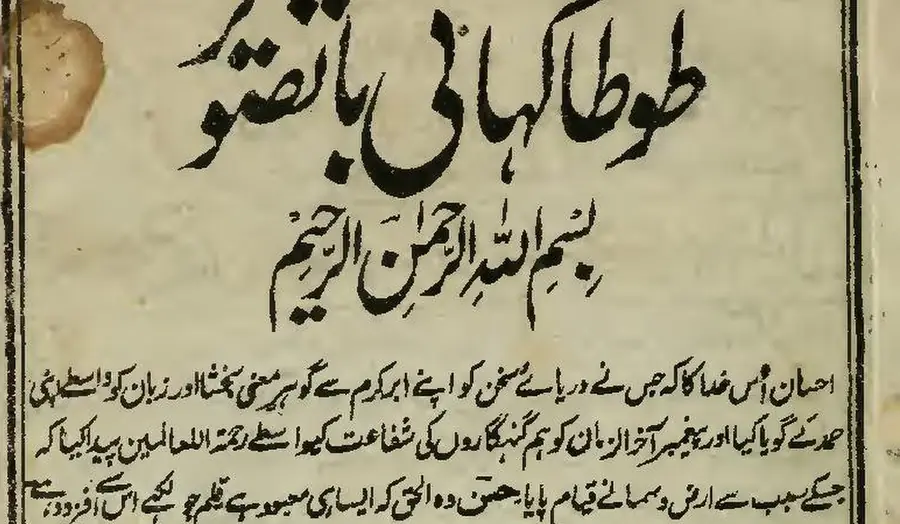
First body line, as printed (Wikisource transcription)
احسان اُس خدا کا کہ جس نے دریائے سخن کو اپنے ابر کرم سے گو ہرِ معنی بخشا اور زبان کو واسطے اپنی
- 9.1% of characters wrong
FastOCR
published by us
احسان اُس خدا کا کہ جس نے دریائے سخن کو اپنے ابر کرم سے گو ہر معنی بخشا اور زبان کو واسطے اپنی
- 9.2% of characters wrong
imagetotext.info
free web tool
احسان اُس خدا کا کہ جس نے دریائے سخن کو اپنے ابر کرم سے گو ہر معنی بخشا اور زبان کو واسطے اپنی
- 30.4% of characters wrong
OCR.space
default Engine 2
احسان أس مداكاكيج سنءريات سخن كواب ابركرم ← كوبر معى تختا اورزيان كوداسطيى
- 55.3% of characters wrong
Tesseract 5.5.4
the engine NewOCR says it uses
ا احمان اس دا اجس ےه در را سخ نکو ان ارک سےکوس ین یناد زا نک ری
- 99.6% of characters wrong
OnlineOCR.net
no Urdu option
tA)K11 tAirk.,....11.30,t4 ikitt r CIO 4 %;114iiii
Reading the results: what the table says and what it does not
Each cell is the share of characters the tool got wrong on one scanned book page, so lower is better. One page per script is a snapshot, and the reference text itself is a volunteer transcription, which is why gaps under three points are called ties.
FastOCR ranged from 1.0% to 9.1% across the six pages shown (lower is better). On Arabic, Urdu, Bengali, Chinese and English the best other tool was within the noise of FastOCR, so those pages count as ties.
Free web forms behaved very differently from one another. imagetotext.info stayed close to FastOCR on the three pages we ran. PDF24 and Tesseract struggled on Urdu. OnlineOCR.net returned Latin letters for the Urdu page (99.6% wrong, lower is better), because its language list does not include Urdu.
The OCR.space row shows two engines on purpose. The default engine rejected Arabic, while the second engine read it, so on that site the engine menu matters more than the tool. See FastOCR and OCR.space. Smallpdf gave one Arabic result and then stopped offering free downloads.
Character error rate and word error rate, in plain terms
Character error rate counts the edits needed to turn the OCR output into the correct text, then divides by the length of the correct text. A wrong, missing or extra character is one edit. Word error rate counts whole words instead, so a single wrong letter spoils the word.
Accuracy is normally 100% minus the error rate, so a 5% error rate (lower is better) becomes a 95% accuracy figure. Vendors do not always say which unit they mean, and a page-level or word-level figure can sit far below a character-level one for the same output.
Our scores remove spaces, punctuation and Arabic diacritics from both texts before comparing, so a missing tashkeel mark does not count against a tool.
Tesseract OCR accuracy, script by script
Tesseract is free, open source and runs on your own machine. We ran version 5.5.4 locally with the matching language pack, one page per script. Its best pages were Tamil and English at 8.5% of characters wrong, and its worst were Chinese, Urdu and Bengali (lower is better; the table above has every figure).
On Arabic, Urdu, Bengali, Tamil, Chinese and English FastOCR was clearly lower. The score is not a verdict on the engine: Tesseract's image-quality guide says resolution, noise, skew and binarisation all change recognition, and a tuned pipeline can beat one untuned run.
Our pages are old, sometimes stained book scans. A clean modern page in a Latin script is the case Tesseract was built around, and we did not measure it. You also choose the language pack yourself. The wrong pack, or none, gives worse output than the figures here, while FastOCR detects the language on its own. For the longer comparison see FastOCR and Tesseract, and the engine's own documentation for the languages it ships.
OCR speed and OCR performance: why this page has no ranking
We did not time any tool, and we hold no dated FastOCR timing to cite, so this page ranks nothing on speed. That includes Tesseract speed. For a hosted tool the wait also includes upload, queueing, page count and server load, which a vendor figure rarely matches.
For Tesseract the main levers are on your side. Its FAQ says version 4 can use the fast integer models and up to four CPU threads per page, that four threads slow things down on a two-core machine, and that OMP_THREAD_LIMIT sets the thread count. Speed is therefore your hardware and settings, not a property of the engine alone.
To get a number you can trust, take ten of your own pages, run each tool on the same files on the same machine or connection, time from submitting the file to holding the text, and repeat at another time of day. Record accuracy for the same run: a quick result that needs a long proofread is slow.
What is a good OCR accuracy rate?
No threshold applies everywhere, because the page decides most of the result. On our six pages FastOCR ranged from 1.0% to 9.1% of characters wrong and Tesseract from 8.5% to 71.9% (lower is better). The same engine can read one script well and another badly.
Turn the rate into wrong characters before judging it: 3% on a 2,000-character page is about 60 wrong characters. That may be fine for search and unacceptable for a price list, a contract or a name.
Scan quality moves the figure as much as the engine. Skew, stains, small print, low resolution and phone shadows all raise it. Treat a single percentage from a vendor with suspicion until you know the script, the kind of page and whether it counts characters or words.
Tesseract against paid cloud OCR: what published studies cover
We tested no paid enterprise product, so we cannot say how Tesseract compares with one. Published studies exist, but each covers a narrow document set.
A 2022 paper in the International Journal of Electrical and Computer Engineering (the paper) compared Tesseract with a commercial cloud OCR service on Thai vehicle registration certificates. One document type in one script says little about books or forms. The EffOCR paper (Efficient OCR for Building a Diverse Digital History) reports character error rate against the same kind of service on historical documents, with Tesseract as a baseline, and historical print behaves differently from modern scans.
Read the tables in the papers themselves, and check the document type, language, engine version and date, because engines change. A neutral explainer of the two engines is in the two engines side by side.
Test OCR on your own files
Pick ten to twenty pages from your real work, type the correct text for a few lines of each, run every candidate on the same files, and compare character by character. The step-by-step version is in how to benchmark OCR on your own documents.
When another tool is the better choice
- Choose Tesseract when you need an engine you can script on your own machine and you are willing to pick and tune a language pack for every script.
- Choose OCR.space when you will select the second engine by hand, or when you want a free API to prototype with.
- Choose imagetotext.info for a single Arabic, Urdu or Bengali image from a free form, where it scored about the same as FastOCR.
- Treat any tool here as untested for your own documents until you run ten of your pages through it.
FAQ
What is a good OCR accuracy rate?
It depends on the page more than the tool. On our six scans FastOCR got between 1.0% and 9.1% of characters wrong and Tesseract between 8.5% and 71.9% (lower is better). At 3% on a 2,000-character page about 60 characters are wrong, so proofread anything that must be exact.
How accurate is Tesseract OCR?
On our pages Tesseract 5.5.4 got 8.5% of English characters wrong and 55.3% of Urdu, and 71.9% of Chinese (lower is better), each with the matching language pack. We ran one scan per script, so this is a snapshot rather than a rating of the engine.
How fast is Tesseract OCR?
We did not time Tesseract or any other tool, so we give no speed figure. Tesseract runs on your own machine, so its speed depends on your hardware, the page size and settings such as thread count. The only reliable number is one you time on your own files.
How do you measure OCR accuracy?
The usual measure is character error rate: the insertions, deletions and substitutions needed to turn the OCR output into the correct text, divided by the length of the correct text. Lower is better. Word error rate works the same way on whole words and is usually harsher.
Is Tesseract better or worse than enterprise OCR?
We tested no enterprise product, so we cannot rank them. On our pages Tesseract did best on Tamil and English (8.5% of characters wrong, lower is better) and worst on Chinese, Urdu and Bengali. Whether a paid engine does better on your files is something to test on them.
How good is OCR in 2026?
Good on clean, well-lit pages in a script the engine supports, and uneven elsewhere. On the same ${shownCountWord()} pages the tools we ran ranged from about 1% of characters wrong to nearly all of them wrong (lower is better). Scan quality, script and language setting matter as much as the engine.
Which OCR tool had the lowest error rate?
Of the six scripts shown (Arabic, Urdu, Bengali, Tamil, Chinese and English), FastOCR had the lowest or tied-lowest error rate on 6 (gaps under 3 points count as ties). OCR.space's second engine was level with FastOCR on Arabic (2.9% against 2.6%, lower is better), and imagetotext.info stayed within a point or so on its three pages.
Method
Six public-domain scanned book pages from Wikimedia Commons, one each in Arabic, Urdu, Bengali, Tamil, Chinese and English, scored against each page's Wikisource transcription. Score: character error rate after removing spaces, punctuation and Arabic diacritics, lower is better. The Wikisource text differs from our own proofread key by 1% to 6%, so gaps under three points are treated as ties. Other tools ran on 31 October 2026 on free tiers with the 1,280-pixel scans; FastOCR's output is from its production API on 25 October 2026, and its Arabic, Urdu and English scans were 500 pixels wide. Tesseract 5.5.4 ran locally with the matching pack. PDF24 ran with the language chosen by hand, and its text was read from the downloaded searchable PDF. OCR.space ran on its public demo key, so its empty Engine 3 results on Tamil, Chinese and English may be rate limiting and are not counted as failures. OnlineOCR.net has no option for most of these scripts, so only Urdu was run. i2OCR and NewOCR sit behind a CAPTCHA, which we do not solve, and CamScanner's web text extraction asks for a sign-in before upload, so none of the three was scored. Vendor facts were checked on 4 November 2026. One page per script is a small sample: it shows a pattern, not a ranking for your documents, and results may not hold after January 2027. We keep the scans, raw outputs and scorer in our repository but have not published them as a download. The Urdu scan is on Wikimedia Commons.
Change log
- 25 May 2026: First published.
- 1 November 2026: Added the script-by-script table and Tesseract results by script.
- 4 November 2026: Moved onto the shared comparison layout; every figure is now read from the evidence files, and the speed section cites Tesseract documentation.